Some cleaning ingredients come and go. Others stick around for centuries. Castile Soap definitely belongs in the second category.
But what exactly is Castile Soap? How does it actually work? And what makes a true soap different from the liquid cleaning products lining supermarket shelves?
In this guide, we’ll get into the chemistry behind it, explore the best ways to use it, look at where it works brilliantly, where it doesn’t, and what happens when you start mixing it with other ingredients.
In short, everything you could want to know about this golden oldie.

Castile Soap AT A GLANCE
Tap a topic to jump to that section.
| What is it? | An ancient soap made by saponifying plant oils. |
|---|---|
| Made from | Traditionally olive oil. Today often a blend of vegetable oils. Ours: Organic Sunflower Oil and Organic Coconut Oil. |
| Why choose it? | Plant-based, biodegradable, concentrated, fragrance-free, cost-effective and versatile. |
| Better for the planet? | Yes. Its cleaning power comes from plant oils, and it’s highly biodegradable. |
| How does it work? | Soap molecules grab grease and dirt so water can rinse them away. |
| How much? | Less than you think. It’s concentrated, so always dilute it. Dilution guide → |
| Good for | Everyday cleaning: kitchens, bathrooms, grease, grime, fabrics and spot cleaning. |
| Mix with | Essential Oils, Bicarbonate of Soda, Soda Crystals, Oxygen Bleach, a little alcohol. |
| Never mix with | Vinegar, Citric Acid or lemon juice. |
| pH | 9 to 10 (alkaline). Great on grease, not on limescale. |
| Hard water? | Can leave residue and streaks. Use distilled or boiled and cooled water. |
| Avoid on | Unfinished, waxed or oiled wood. Test unfamiliar surfaces first. |
| Disinfectant? | No. It’s a cleaner, not a disinfectant. |
| Storage | Tightly closed, cool, dry, away from sunlight and heat. |
| Our take | Oldie but goldie. Simple, effective and it does the job. |
What Is Castile Soap?
Castile Soap is a true soap made from vegetable oils, not a synthetic detergent. Originating in the Castile region of Spain, it has a long soapmaking history. Traditionally made with olive oil, it became known for its simple, natural formula. And there’s a good reason it has found its way into modern cleaning cupboards too. It’s plant-based, versatile and simple to use. One concentrated bottle can take on a whole host of cleaning jobs, helping you cut down on the number of products you need without cutting corners on everyday cleaning.
Castile Soap was already reaching England by the 1560s. But by the 1630s, soap had become political. Charles I granted a soapmaking monopoly to a Westminster society suspected of Catholic sympathies, and a 1637 proclamation even restricted soap imports to protect it. Critics called its product “Popish Soap”. Who knew soap could make waves beyond the sink? Read more about the English “Popish Soap” Controversy →
So, what actually makes Castile Soap a true soap? It’s made by transforming plant oils into soap through a chemical reaction called saponification. During this process, the oils react with an alkali to create soap molecules that can lift dirt, oil and grease from surfaces and carry them away with water. How saponification turns oils into soap →
A glimpse into the traditional craft of soap making

»Der Seifensieder« (Seifensieder). Kupferstich von Christoph Weigel.
© »Abbildung der Gemein-Nützlichen Haupt-Stände …«. Regensburg 1698.
And this is where Castile Soap gets particularly interesting. Many products sold as liquid soap aren’t actually soap at all. They’re synthetic detergents. Instead of being made by saponifying oils, synthetic detergents use surfactants to create their cleaning action, often alongside many other ingredients that add fragrance, colour, texture, foam and extend shelf life.
What Is Castile Soap Made Of?
Our Organic Castile Soap is made from Organic Sunflower Oil and Organic Coconut Oil. Both are plant oils, but their fatty acids bring different properties to the finished soap.
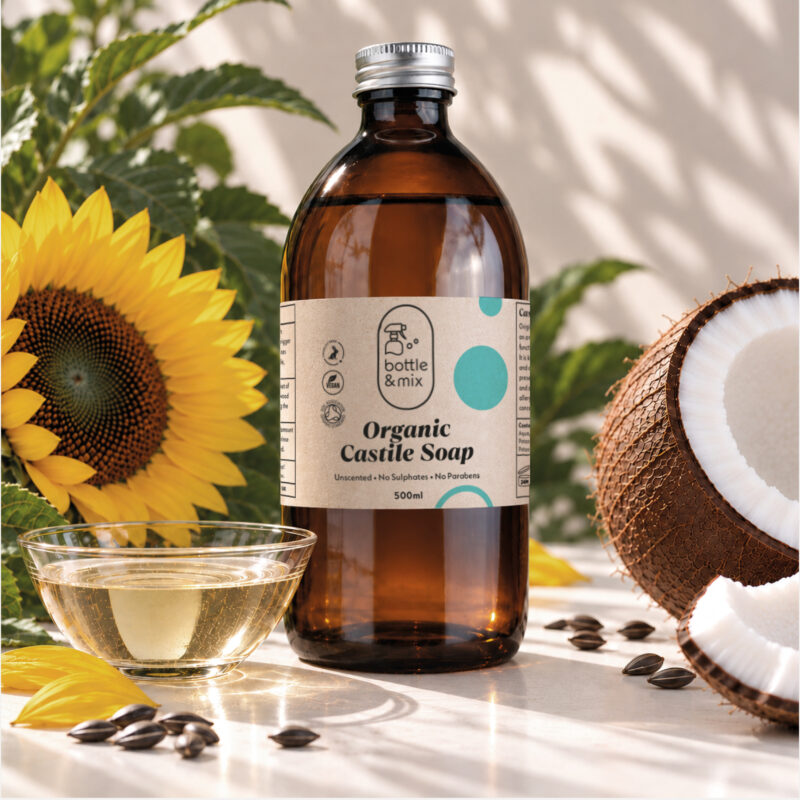
The ingredients in our Organic Castile Soap are:
- Aqua: the liquid base.
- Potassium Oleate: the potassium salt of oleic acid, which is abundant in Sunflower Oil. It helps lift oils and grease so they can be rinsed away.
- Potassium Cocoate: soap made from the fatty acids found in coconut oil. It contributes to cleansing, solubility and lather.
- Glycerin: a natural by-product of saponification and a humectant, meaning it attracts and helps retain moisture.
- Potassium Citrate: helps control the formulation and can bind minerals in hard water.
- Citric Acid: neutralises any excess alkali left over from soapmaking and forms Potassium Citrate, which helps soften hard water.
Potassium Oleate and Potassium Cocoate are the cleaning workhorses. As surfactants, they have one end that is attracted to water and another that is attracted to oils and grease. This lets them surround oily dirt, lift it from the surface and carry it away when you rinse.
The ORIGINAL Castile Soap RECIPE VS. MODERN Castile Soap:
Traditional Castile Soap was made with olive oil. Modern Castile Soaps often use other vegetable oils too, such as coconut, palm, hemp, jojoba, almond, avocado or walnut oil, and they’re often blended together. These days, we simply have a few more tricks up our sleeves.
So why did we swap olive oil for sunflower and coconut? Olive oil makes a lovely, gentle soap, but on its own it doesn’t lather much. Like olive oil, sunflower oil is a gentle liquid oil and a source of oleic acid, so it keeps that mild cleansing. Coconut oil brings lauric acid and other shorter-chain fatty acids, which help the soap dissolve in water and give it a good lather. Together, they make a soap with a useful balance of cleansing, solubility and lather. Research on fatty acids in soap →
And while the recipe may have evolved, the basic chemistry hasn’t:
Vegetable Oils + alkali + a little soapmaking know-how = soap.
Our Castile Soap Has a Simple Formula for a Reason.
Most shop-bought cleaners are mostly water, sold in a new single-use plastic bottle every time, with fragrance, colour, preservatives and foam boosters added so they look, smell and feel “clean”. Heavy to ship, quick to run out and easy to keep buying. You end up paying for the water, the plastic, the perfume and the advert.
Ours is concentrated soap. You add the water at home, and you only pay for the cleaning.
Keeping it simple means:
 Vegan: made entirely from plant oils, with no animal fats or animal-derived ingredients.
Plant-based: made from Organic Sunflower Oil and Organic Coconut Oil.
Biodegradable: the soap compounds can be broken down by microorganisms. Biodegradability study →
Highly concentrated: a little goes a long way, so one bottle can make multiple cleaning solutions.
Economical: one versatile soap can take the place of several specialist cleaning products.
Fragrance-free: no added perfume or Essential Oils. Fragrance ingredients are recognised causes of allergic contact dermatitis. Scientific review →
Certified organic: made with certified organic plant oils.
Cruelty-free: not tested on animals.
No petroleum-derived surfactants:the cleaning agents come from plant oils.
 No parabens: preservatives that have been investigated for potential endocrine effects. Scientific review →
No phthalates: chemicals used mainly as plasticisers, with some also used in fragrance-related applications. Scientific review →
No MI or MCI: preservatives with well-established potential to cause allergic contact dermatitis. Research on contact dermatitis →
No triclosan: we don’t need an antibacterial chemical to make soap clean. The FDA found insufficient evidence that antibacterial soaps work better than ordinary soap and water at preventing illness. FDA information →
No quats: no added antibacterial compounds such as benzalkonium chloride. Quaternary ammonium compounds are widely used in disinfectants and some can cause skin irritation and sensitisation. Scientific review →
No artificial foaming agents: the lather comes from the soap itself.
Simple ingredients. Everything you need, and nothing you don’t.
Why Castile Soap Is a Safer, More Environmentally Responsible Choice.
There are two broad groups of soap-like cleaning products: true soaps made from plant oils, like Castile Soap, or animal fats and oils, and synthetic detergents made from manufactured surfactants and other additives.
Liquid Castile Soap belongs to the simpler end of that spectrum. Its cleaning action comes from soap molecules made from plant oils, rather than a blend of synthetic detergents, fragrances and other additives.
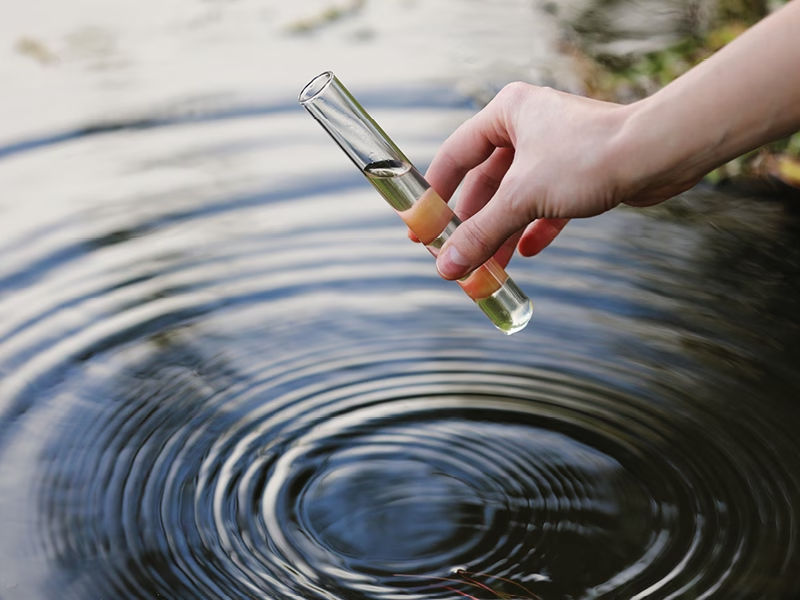
And there’s some interesting science behind that simplicity. A 2025 peer-reviewed study found that potassium oleate, one of the soap compounds in our formulation, was highly biodegradable and showed significantly higher human skin-cell viability than the synthetic surfactant SLS under the conditions tested. Read the PLOS ONE study →
How Does Castile Soap Work?
The cleaning power of Liquid Castile Soap comes down to some wonderfully simple chemistry.
Soap molecules have two very different sides. They are amphiphilic, which simply means that one end likes water while the other prefers oil and grease.
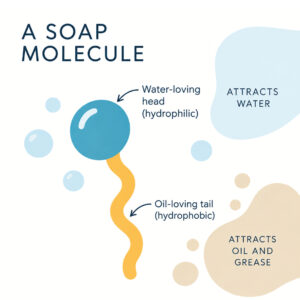
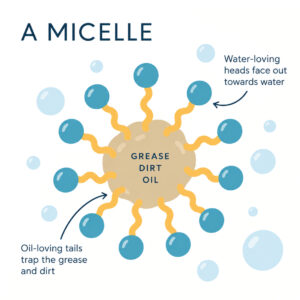
When you add soap to water, the oil-loving ends attach to grease and oily dirt, while the water-loving ends interact with the surrounding water. Soap molecules can gather around oily dirt to form tiny structures called micelles, helping to lift it from the surface.
When you rinse, the loosened dirt and grease can be carried away with the water rather than clinging to the surface.
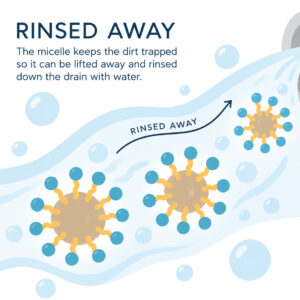
That’s why Castile Soap can tackle everything from greasy fingerprints and food residue to everyday household grime.
Simple, really. And that’s the clever bit about soap.
How Much Castile Soap to Use
Castile Soap is concentrated, so for most jobs it needs diluting. These are the amounts we use, and all our recipes follow them.
| Job | Castile Soap | Water |
|---|---|---|
| All-Purpose Spray, Car Interior | 1 tbsp (15 ml) | 250 ml |
| Window & Glass | ½ tsp (2.5 ml) | 250 ml |
| Dusting, Furniture & Woodwork | 1 tsp (5 ml) | 500 ml |
| Daily Toilet Cleaner | 1 part (50 ml) | 4 parts (200 ml). Use neat on stubborn marks. |
| Washing Up | 1 part, or 1 to 2 tbsp | 10 parts, or a full sink |
| Hard Floors, Walls | 2½ tbsp (about 40 ml) | 4 litres warm water |
| Hand-Washing Delicates | 2 tbsp (30 ml) | 4 litres cold water |
| Fruit & Veg | ¼ tsp | 1 litre cold water |
| Makeup Brushes | 1 to 2 drops | a cup of warm water |
| Carpet & Rug Spots, Dog Shampoo | a small amount, neat | rinse well afterwards |
1 tbsp = 15 ml, 1 tsp = 5 ml. In a hard-water area, use distilled or boiled and cooled water to keep soap residue to a minimum.
15 Ways to Use Castile Soap for Cleaning
Liquid Castile Soap is a proper multi-tasker and can replace a multitude of cleaning products in your home. Plus, it’s highly concentrated, so a tiny drop is all you need for many cleaning jobs. Just dilute it with water and one bottle goes a very long way.
From kitchen grease to bathroom grime and everyday household cleaning, this is just a glimpse of what Liquid Castile Soap can do.
Ready to put that bottle to work? Here are 15 of our favourite ways to use it around your home.
A simple everyday cleaner for kitchen surfaces, tables, worktops and other washable surfaces. One bottle, plenty of cleaning jobs.
Method: Mix 1 tbsp Organic Castile Soap with 250 ml distilled water or boiled and cooled water. Add 5 to 10 drops of 100% Pure Essential Oils if desired. Pour into a spray bottle and shake gently. Spray, leave for 5 to 10 minutes, then wipe clean with a Premium Microfibre Cloth and dry.
A simple way to clean windows, mirrors and other glass surfaces without overcomplicating things.
Method: Mix ½ tsp (2.5 ml) Organic Castile Soap with 250 ml distilled water or boiled and cooled water. Pour into a spray bottle and shake gently. Spray sparingly onto a Fishscale Microfibre Glass Cloth rather than directly onto the glass. Wipe from top to bottom, then buff with a clean, dry glass cloth to remove remaining moisture and leave the surface streak-free.
A soft, gently abrasive paste that deodorises, degreases and cleans. It’s particularly useful for worktops, sinks, tubs, taps, appliances and toilets.
Method: In a bowl or jar, mix Bicarbonate of Soda with a little Organic Castile Soap. Add a few drops of water, just enough to make a soft, creamy paste. Add 10 drops of 100% Pure Essential Oils if desired. Apply with a sponge or brush and scrub gently, then rinse off or wipe away with a damp Premium Microfibre Cloth.
Please note: Don’t use Soft Scrub on glass, aluminium, natural stone or wood, or on antique silver or gold-plated items.
A gentle cleaner for removing dust, fingerprints and light grime from sealed wooden furniture and painted woodwork.
Method: Mix 1 tsp Organic Castile Soap with 500 ml lukewarm distilled water. Dampen a Premium Microfibre Cloth with the solution and wring it out well. Wipe the surface gently, then dry immediately with a clean, dry cloth.
Please note: Always test on an inconspicuous area first. Do not use on unfinished, waxed or oiled wood.
A simple way to clean and freshen your toilet between deeper cleans.
Method: Mix 50 ml Organic Castile Soap with 200 ml boiled and cooled water (1 part soap to 4 parts water). Add 5 to 10 drops of 100% Pure Essential Oils if desired. Pour into a spray bottle, spray around the bowl and leave for 5 to 10 minutes. Scrub with a toilet brush, then flush. For stubborn marks, put a few drops of neat Castile Soap straight onto the toilet brush.
A simple way to clean washable hard floors, including many sealed surfaces.
Method: Add 2½ tbsp (about 40 ml) Organic Castile Soap to 4 litres of warm water. Use lukewarm water for heat-sensitive floors such as wood. Mop without soaking the floor. If you notice a white residue, particularly in hard-water areas, rinse with clean water.
A gentle solution for removing everyday marks, dust and grime from washable walls.
Method: Add 2½ tbsp (about 40 ml) Organic Castile Soap to 4 litres of warm water. Dip a Premium Microfibre Cloth into the solution and wring it out well. Wipe the wall gently, then remove any residue with a clean, damp cloth and allow to dry.
Liquid Castile Soap can be used directly on many everyday stains, making it a handy first step before reaching for a stronger stain treatment.
Method: Apply a small amount of Organic Castile Soap directly to the stain. Gently work it into the fabric with a damp Premium Microfibre Cloth and leave for a few minutes. Rinse or wash as usual, following the fabric’s care instructions.
For tougher stains: Try our Miracle Stain Remover, which combines Castile Soap with Bicarbonate of Soda and Oxygen Bleach for more stubborn marks.
Looking for the right treatment for a particular stain? Read our complete stain guide →
A gentle option for washing delicate clothing by hand.
Method: Add 2 tbsp (30 ml) Organic Castile Soap to 4 litres of cold or lukewarm water. Add the clothing and soak for at least 10 minutes. Rinse thoroughly, gently press out excess water, then hang or lay flat to dry as appropriate.
A simple, gentle way to clean your dog’s coat using Liquid Castile Soap.
Method: Wet your dog’s coat with lukewarm water. Apply a small amount of Organic Castile Soap and gently massage it through the coat to create a light lather. Avoid the eyes, ears, nose and mouth. Rinse well with clean water until all traces of soap are removed. Repeat if needed.
Please note: Always rinse thoroughly and stop if your dog shows any signs of irritation.
A simple natural spray that cleans away ant trails while helping keep ants at bay. Peppermint, Tea Tree and Lemon Essential Oils can help deter ants with their strong natural scents.
Method: Use the All-Purpose Cleaner solution made with 1 tbsp Organic Castile Soap and 250 ml distilled or boiled, cooled water. Add 10 to 15 drops of 100% Pure Essential Oils, preferably Peppermint, Tea Tree or Lemon, then shake gently. Spray along ant trails and in areas where you want to keep ants away.
Please note: Avoid spraying directly onto plants, as the solution may cause damage.
A light cleaning spray for removing dust, fingerprints and everyday grime from furniture and other washable surfaces.
Method: Mix 1 tsp Organic Castile Soap with 500 ml distilled or boiled, cooled water in a spray bottle. Shake gently, spray lightly onto a Premium Microfibre Cloth, then wipe the surface clean.
Please note: Spray sparingly and avoid using on unfinished, waxed or delicate surfaces. Test on an inconspicuous area first.
simple way to tackle small stains and everyday marks on carpets and rugs using Liquid Castile Soap.
Method: If the stain is still wet, gently blot with a clean Premium Microfibre Cloth to absorb as much as possible. Don’t rub. Wet the stained area with a small amount of water, then dab a little Organic Castile Soap directly onto the stain. Gently work it in with the Premium Microfibre Cloth, then rinse with clean water and blot with a clean, damp cloth to remove any soap and lifted dirt. Allow to dry completely.
Please note: Always test on an inconspicuous area first, particularly on delicate or natural fibres.
A simple way to clean car dashboards, door panels, plastic, vinyl and other washable interior surfaces using Liquid Castile Soap.
Method: Mix 1 tbsp Organic Castile Soap with 250 ml distilled or boiled and cooled water. Pour into a spray bottle and shake gently. Spray lightly onto a Premium Microfibre Cloth, then wipe the surface clean. Follow with a clean damp cloth to remove any remaining soap, then dry.
Please note: Test on an inconspicuous area first. Avoid screens, electrical components, leather and delicate or unsealed surfaces.
A simple, gentle way to clean makeup brushes using Liquid Castile Soap.
Method: Add a few drops of Organic Castile Soap to a cup of warm water. Rinse your brushes first, then gently swirl them in the solution to create a light lather. Leave them to soak for around 10 minutes, rinse thoroughly and lay flat to air dry.
Explore all our natural cleaning recipes →
Can You Mix Castile Soap with Other Cleaning Ingredients?
A lot of cleaning recipes online squeeze a whole lot of ingredients into one bottle. The more ingredients, the better, right?
Well, that’s not quite how it works. When making your own cleaning products, keep it simple. Some ingredients react and cancel each other out, so your cleaner can end up doing less, not more.
And a quick word before you start mixing: not every combination is harmless. Some can create toxic fumes or dangerous reactions. Castile Soap isn’t going to blow up your kitchen, thankfully, but mix it with the wrong ingredient, and you can end up with an oily, curdled mess. Before You Start guide →
Let’s look at what makes chemical sense, what doesn’t, and what is better kept in separate bottles.
Can You Mix Castile Soap with Essential Oils?
Essential Oils are a natural match for Castile Soap. They add natural scents and can give cleaning recipes an extra purpose.
But don’t fall into the “more is better” trap. Essential Oils are highly concentrated, so a few drops can go a surprisingly long way. Adding too much can also affect the soap’s consistency, which is another good reason to keep the amounts sensible.
Want to know more about using Essential Oils instead of synthetic fragrance?
Can You Mix Castile Soap with Bicarbonate of Soda?
A very good match.
Bicarbonate of Soda adds gentle scrubbing power while Castile Soap helps lift grease and grime. That’s exactly why we use them together in our Soft Scrub.
Not sure when to use Bicarbonate of Soda and when to reach for something stronger?
Can You Mix Castile Soap with Soda Crystals?
Yes, when you need more muscle.
Soda Crystals are a powerful alkaline cleaner and water softener. They can help tackle heavily soiled laundry, grease and stubborn dirt, while softening hard water so soap can work more effectively.
They can be used alongside Castile Soap, but they’re much more alkaline than you need for everyday cleaning. That extra cleaning power comes with a downside. Soda Crystals can be harsh on some fabrics, finishes and surfaces, particularly at higher concentrations, and can react with certain materials. They’re tough on skin too, so wear gloves.
So save them for the jobs that really need the extra muscle. Castile Soap is great for everyday cleaning. Soda Crystals are your heavy-duty helper.
Can You Mix Castile Soap with Oxygen Bleach?
Yes, at the point of use
Oxygen Bleach and Castile Soap can work well together. They simply do different jobs. Oxygen Bleach helps break down stains and organic discolouration, while Castile Soap helps lift dirt and grease.
The important bit is timing. Once Oxygen Bleach is dissolved in water, it starts releasing active oxygen and gradually loses its strength.
So if you’re combining the two, mix it fresh and use it while it’s active. Don’t make up a bottle and expect it to work weeks later. And never seal the mixture in a closed bottle. It keeps releasing oxygen, and that pressure has to go somewhere.
Can You Mix Castile Soap with Alcohol?
Yes, but keep it low
Alcohol can be combined with Castile Soap and helps the solution dry faster with fewer streaks, although it can reduce the soap’s foaming action. Keep the concentration low, around 5% or less.
Alcohol can also be used after cleaning with Castile Soap when a separate alcohol-based disinfecting step is appropriate.
And remember: if you’re using alcohol for disinfecting, clean first. Dirt and organic matter can interfere with the disinfecting process, so you can’t disinfect properly without cleaning first.
We’ll come back to this in Is Castile Soap a Disinfectant?
Can You Mix Castile Soap with Vinegar, Citric Acid or Lemon Juice?
No. This is one combination to leave alone.
Vinegar, Citric Acid and lemon juice are all acidic, while true soap such as Castile Soap is alkaline. When you mix an acid with Castile Soap, the acid reacts with the soap molecules and pushes them back towards their fatty-acid form.
Instead of creating a super-powered cleaner, you can end up with a cloudy, curdled or oily mixture that cleans poorly and can leave residue behind.
So don’t mix Castile Soap with vinegar, Citric Acid or lemon juice in the same bottle.
Use them separately instead. Clean with Castile Soap first, wipe over with clean water, then reach for the acid. Castile Soap is excellent for lifting grease and everyday dirt, while acids such as Citric Acid are much better suited to tackling limescale and mineral deposits.
Want to understand why? pH, Acids & Bases →
And when limescale is the problem, Citric Acid Multipurpose Cleaner →
Can You Mix Castile Soap with Chlorine Bleach?
No. Keep chlorine bleach out of your DIY cleaning recipes.
Chlorine Bleach is highly reactive. Mixing bleach with acids such as vinegar or Citric Acid can release toxic chlorine gas. Castile Soap is a different case, but bleach can still react with the soap’s organic ingredients, potentially changing the soap and producing unwanted by-products.
Keep it simple: never mix chlorine bleach with anything. Use it on its own, exactly as directed on the label.
For more on cleaning chemistry, acids, bases and safe combinations, see our Before You Start guide →
For more on the difference between chlorine bleach and Oxygen Bleach, see our Oxygen Bleach vs Chlorine Bleach guide →
What Are the Downsides of Castile Soap?
Does Castile Soap work in Hard Water?
Hard water and soap aren’t the best of friends. This affects all true soaps, not just Castile Soap. The calcium and magnesium in hard water react with soap molecules to form insoluble deposits, often called soap scum. These can cause cloudiness and streaks, and they use up some of the soap before it gets to clean.
How hard is your water? Across the UK it varies a lot. Much of Scotland, Wales, Northern Ireland and the north and west of England have soft to moderately hard water, which suits soap rather well. Much of southern and eastern England is hard. Your water supplier publishes the hardness for your postcode, so it’s worth a quick check.
If you live in a hard-water area, distilled water is your safest bet when making Castile Soap cleaning solutions. It contains far fewer dissolved minerals, helping to keep residue to a minimum.
No distilled water to hand? Try these tricks:
- Try cooled boiled water. Boiling helps reduce temporary water hardness by removing some of the minerals responsible for soap residue. It won’t remove all the minerals, but it’s a practical alternative.
- Use less soap. It’s concentrated, so more isn’t better. Too much can leave a film.
- Rinse well. Don’t let soapy residue dry on the surface.
- Buff it up. A clean, dry Microfibre Cloth helps remove light streaks from glass and other shiny surfaces.
- Got soap scum or mineral deposits? An acidic rinse, such as a diluted Citric Acid solution, helps dissolve them on suitable surfaces. Clean with Castile Soap first, rinse with clean water, then follow with the acid. Just keep them in separate bottles, as acids and soap cancel each other out. pH, Acids & Bases →
Hard water isn’t a deal-breaker. It just means a little extra know-how!
Use the right cleaner for the right job
Liquid Castile Soap is alkaline, with a pH of around 9 to 10, making it particularly good at lifting everyday dirt, grease and oily grime. Acidic cleaners (like a Citric Acid Cleaner) are better suited to limescale, rust and other mineral deposits.
Remember those chemistry lessons about acids and bases at school? No? Us neither.
Here’s a quick refresher on the pH scale and what it all means for your cleaning cupboard.

Want to know more about why mixing acids and bases in your cleaning products doesn’t always end well? Have a look at our Natural Cleaning Chemistry guide →
And while Castile Soap is excellent for cleaning, it isn’t a disinfectant. We’ll come back to this in Is Castile Soap a Disinfectant?
A little does go a long way
One of the biggest cleaning mistakes is thinking more cleaner means more cleaning power. It doesn’t.
The great thing about Liquid Castile Soap is that it’s concentrated, so a little goes a long way. For most cleaning jobs, a small amount diluted with water is all you need. For targeted jobs such as spot cleaning, you can use a tiny amount neat.
One bottle can take care of a whole lot of cleaning jobs, meaning less product, fewer bottles and less clutter under the sink.
Castile Soap on Waxed and Oiled Surfaces
Because soap is good at lifting oily material, using it regularly over time can affect some waxed or oil-based finishes. For most everyday finished surfaces, use it appropriately diluted and test an inconspicuous area first.
Keep It Out of the Dishwasher and Washing Machine
Dishwashers and washing machines are designed for low-foaming detergents. Castile Soap foams far too much for them, and in hard water it can leave residue on dishes and clothes. Use it for washing up and hand-washing instead.
A few rules, yes. But we’ll happily give it cupboard space.
Is Castile Soap a Disinfectant?
The short answer is no.
Castile Soap is a cleaner, not a disinfectant. It works as a surfactant, helping to loosen dirt, grease and microorganisms so they can be lifted from a surface and wiped or rinsed away. In most situations, cleaning with soap and water is enough to remove most germs from household surfaces.

But there’s something rather clever going on here too. Soap can disrupt the fatty outer envelope of some viruses, particularly enveloped viruses, helping to inactivate them. Combined with washing and rinsing, which physically remove viruses and their fragments, this is one reason ordinary soap and water are so effective for handwashing. How soap disrupts enveloped viruses →
That doesn’t make Castile Soap a disinfectant, though. Disinfecting means using a product specifically intended to kill or inactivate microorganisms on a surface. Cleaning and disinfection explained →
Clean first. Disinfect second.
This is where things often get muddled.
Cleaning and disinfecting are two different jobs. Cleaning removes dirt, grease and most germs. Disinfecting is the extra step used when you specifically need to kill germs that may remain on the surface.
And importantly, you should clean before you disinfect. Dirt and other organic material can make it harder for a disinfectant to reach and kill microorganisms effectively. Clean before disinfecting →
So rather than trying to make one bottle do everything, clean with your Castile Soap solution first, then use a suitable disinfectant separately when disinfection is actually needed.
That might be an appropriate alcohol-based disinfectant, hydrogen peroxide-based product or another approved disinfectant. Always follow the product instructions, including the required contact time. The surface needs to stay wet for the full contact time for the disinfectant to work properly. Disinfectant contact time →
Do you really need to disinfect?
Usually, no.
For everyday household cleaning, good old soapy water is remarkably effective. It removes dirt, grease and most germs from surfaces. In most situations, cleaning with soap and water is enough. Disinfecting at home is generally only needed when someone is sick, has recently been sick, or there is another specific reason to do it. When to disinfect →
Disinfectants have their place, but they aren’t completely harmless either. Some can cause skin, eye or respiratory irritation, and misuse can cause serious harm. This is where targeted hygiene comes in: rather than trying to disinfect everything, the idea is to focus on the areas and situations where disinfection is actually needed. Learn about targeted hygiene →
For everyday cleaning, reach for the soapy water first. Save the disinfectant for when you actually need it.
Frequently Asked Questions
Does Castile Soap go off?
Undiluted, it keeps for a long time if stored tightly closed, somewhere cool and dark. Once you dilute it, it has a shorter shelf life: homemade cleaners typically last around 4 to 8 weeks when made with boiled or distilled water. Mix small batches as you need them, and if a solution starts to smell odd, pour it away and make a fresh one. Before You Start guide →
Is Castile Soap antibacterial?
No. It’s a cleaner, not a disinfectant. It lifts dirt, grease and most germs so they can be rinsed away, which is usually all you need. Is it a disinfectant? →
Is Castile Soap safe around pets?
Diluted Castile Soap is gentle enough that we use it for our Dog Shampoo. Be careful with Essential Oils, though: some, like Tea Tree, can be harmful to cats and dogs, so leave them out of anything your pets will touch.
Why has my Castile Soap mixture gone cloudy or curdled?
Usually it’s been mixed with something acidic, like vinegar or lemon juice, or it’s reacting with hard water. Mix it with distilled or boiled and cooled water and keep acids in a separate bottle. What you can and can’t mix →
Is Castile Soap safe for septic tanks?
It’s biodegradable, so in normal household amounts it’s generally considered septic-safe.
The Bottom Line: Why Castile Soap Is a Simple Everyday Cleaner

Oldie but goldie.
Some things just stand the test of time. Castile Soap is one of them.
In a world of complicated cleaning products, long ingredient lists and a different bottle for every job, there’s something rather refreshing about keeping things simple.
You don’t need a complicated formula for a simple mess. You need something that does the job.
Soap, water and a little know-how will get you a long way. Castile Soap has been around for centuries, and the chemistry is straightforward. It still does what soap has always done: CLEAN.
There’s an environmental and ethical side to that too. Castile Soap is made from plant oils and is typically vegan, cruelty-free and biodegradable. When you need less product and can replace several everyday cleaners with one concentrated soap, there’s less packaging, less clutter and less to buy.
A little goes a long way. For many cleaning jobs, it can be diluted with water, so one bottle can last for months depending on how you use it. A tiny amount can also be used neat for more targeted jobs.
And that’s really the point: Castile Soap will do the job.
It isn’t a disinfectant, and some jobs still call for a specialist cleaner or cleaning product. For everyday cleaning, though, it’s an effective, versatile all-rounder.
A golden oldie for a reason. It works, no need to reinvent the wheel.
Written by Francika Tidlacka, founder of Bottle and Mix.